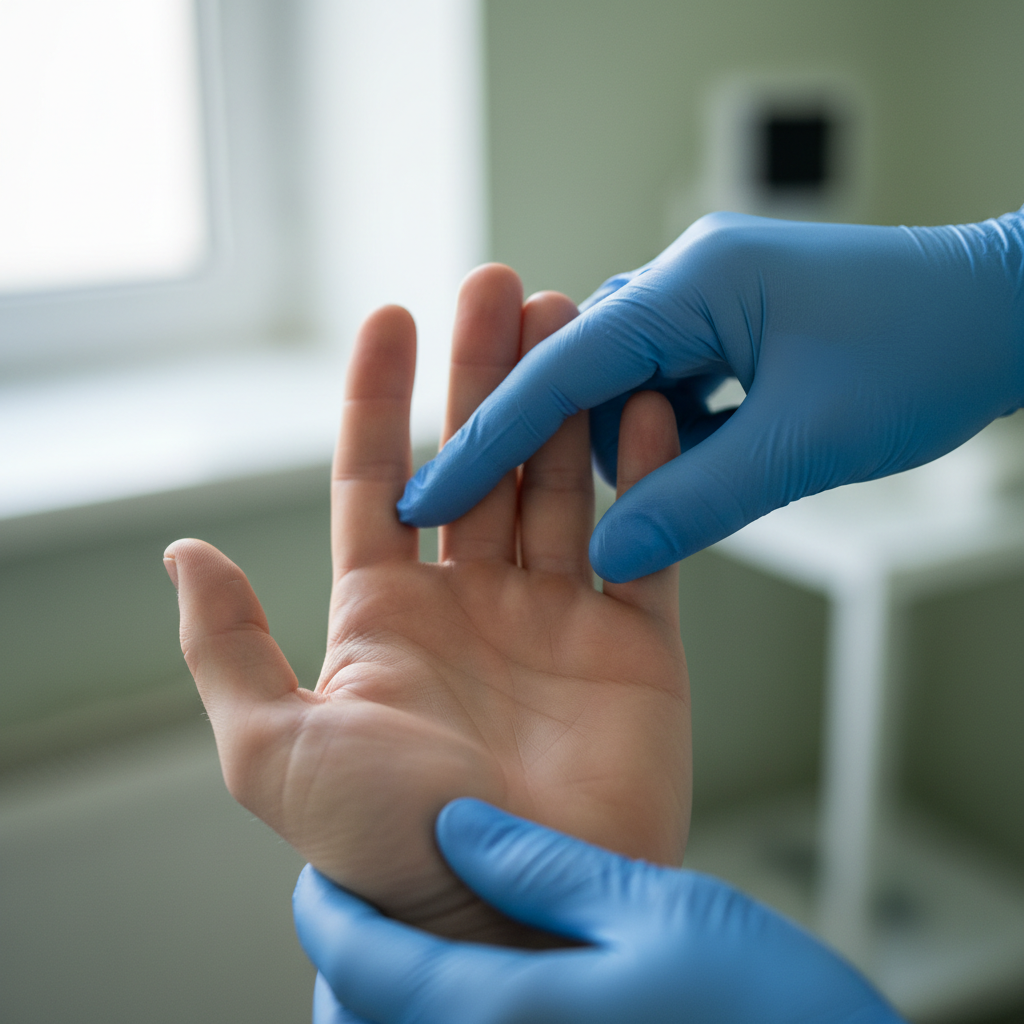
Avg. Recovery
6–12 weeks
to full grip strength
5 conditions covered
Your Hands, Explained.
Understand your condition, your options, and your recovery —
before your first appointment.
Jump to a condition
Educational content reviewed by board-certified hand surgeons
Carpal Tunnel
The nerve that wakes you up at 3am
A narrow passage in your wrist — the carpal tunnel — compresses the median nerve, causing tingling, numbness, and weakness that starts subtle and slowly steals the precision from your hands.
Median Nerve Cross-Section
The carpal tunnel is formed by eight small carpal bones and the transverse carpal ligament. When swelling narrows this channel, the median nerve — responsible for sensation in your thumb, index, middle, and half of your ring finger — gets pinched.
What's Happening Inside
Fluid and inflammation narrow the tunnel. The median nerve, unlike tendons, has no tolerance for pressure — even mild compression disrupts the electrical signals it carries.
Think of the nerve like a garden hose. When you kink it, water still flows — but weakly. Sustained compression causes myelin (the nerve's insulation) to thin, which is why symptoms worsen at night when fluid redistributes to your wrist.
Take This With You
Download Your Carpal Tunnel Guide
A clean, printable PDF of everything on this page — the anatomy, the symptom checklist, the procedure walkthrough, and the week-by-week recovery calendar. Bring it to your first appointment.
- Labeled anatomical diagrams
- Symptom reference checklist
- Questions to ask your surgeon
- Recovery milestone calendar
Trigger Finger
When your finger gets stuck mid-thought
A tendon sheath that has thickened around the A1 pulley at the base of your finger catches on each bend, producing a click, a lock, or a finger that refuses to straighten without your other hand's help.
Flexor Tendon & Pulley System
Tendons are held close to the bone by a series of pulleys — like a fishing line through rings. The A1 pulley sits at the base of each finger. When the tendon develops a nodule from repeated friction, it catches on this pulley every time you flex.
What's Happening Inside
Repetitive gripping inflames the tendon sheath. The body's repair process creates scar tissue that forms a nodule. Each bend forces this nodule through the tightened A1 pulley.
In the morning, after hours of reduced circulation, the nodule swells slightly and the pulley is at its tightest. This is why trigger finger is worst at breakfast and loosens as the day warms your hand.
Take This With You
Download Your Trigger Finger Guide
A clean, printable PDF of everything on this page — the anatomy, the symptom checklist, the procedure walkthrough, and the week-by-week recovery calendar. Bring it to your first appointment.
- Labeled anatomical diagrams
- Symptom reference checklist
- Questions to ask your surgeon
- Recovery milestone calendar
Dupuytren's
The cord pulling your finger toward your palm
Abnormal collagen cords form beneath the skin of the palm and progressively pull the ring and little fingers toward the palm — a process so slow most patients don't notice until the contracture is 30 degrees or more.
Palmar Fascia & Dupuytren's Cord
The palmar fascia is a sheet of connective tissue beneath the skin of the palm. In Dupuytren's, specific cells (myofibroblasts) produce abnormal collagen that contracts. The cord forms along the natural fascial bands, drawing the finger into flexion.
What's Happening Inside
The condition is genetic — Northern European ancestry carries the highest risk — and progresses in nodules first, then cords. It is not caused by manual labor or injury, though these are common misconceptions.
The contracture is painless in most cases, which is why patients delay seeking care. The 'tabletop test' is simple: if you can't lay your hand flat on a table, the contracture is significant enough to evaluate for treatment.
Take This With You
Download Your Dupuytren's Contracture Guide
A clean, printable PDF of everything on this page — the anatomy, the symptom checklist, the procedure walkthrough, and the week-by-week recovery calendar. Bring it to your first appointment.
- Labeled anatomical diagrams
- Symptom reference checklist
- Questions to ask your surgeon
- Recovery milestone calendar
Fractures
When the scaffolding inside your hand breaks
Hand and wrist fractures range from the boxer's fracture from a punch to the distal radius fracture from catching yourself in a fall. The difference between a fracture that heals with a cast and one that needs a plate often comes down to a few millimeters of displacement.
Hand & Wrist Bone Architecture
The hand contains 27 bones — 8 carpal bones in the wrist, 5 metacarpals forming the palm, and 14 phalanges in the fingers. Each joint must align precisely. A fracture that heals in the wrong position permanently alters grip mechanics.
What's Happening Inside
Bone breaks when force exceeds its tensile strength. The pattern — transverse, spiral, comminuted — tells the surgeon how the force was applied and predicts whether the fracture will stay in position in a cast or requires fixation to hold alignment.
The first 48 hours matter most. Swelling peaks at 72 hours, making reduction harder. X-rays taken immediately after injury show the true displacement before swelling obscures the anatomy.
Take This With You
Download Your Hand & Wrist Fractures Guide
A clean, printable PDF of everything on this page — the anatomy, the symptom checklist, the procedure walkthrough, and the week-by-week recovery calendar. Bring it to your first appointment.
- Labeled anatomical diagrams
- Symptom reference checklist
- Questions to ask your surgeon
- Recovery milestone calendar
Tendon Repair
Reconnecting the cables that move your fingers
Flexor tendons in the finger are under constant tension — a deep cut can sever them completely, leaving a finger that curls passively but cannot flex under your control. The repair requires microsurgical precision and a carefully orchestrated rehabilitation protocol.
Flexor Tendon Zones
The hand is divided into five flexor tendon zones. Zone II — 'no man's land' — runs from the palm crease to the middle of the finger. Repairs here are the most technically demanding because two tendons run within a tight sheath, surrounded by pulleys that must be preserved.
What's Happening Inside
Tendons are collagen cables with almost no elasticity. When cut, the proximal end retracts into the palm under the pull of the forearm muscle. The window for primary repair — sewing the cut ends together — is 10–14 days before scarring makes retrieval difficult.
The strength of a tendon repair is at its lowest at 5–7 days post-surgery, then climbs steadily as collagen remodels. This is why the early rehabilitation protocol is precisely timed — too passive and the tendon scars to its sheath; too aggressive and it ruptures.
Take This With You
Download Your Tendon Repair Guide
A clean, printable PDF of everything on this page — the anatomy, the symptom checklist, the procedure walkthrough, and the week-by-week recovery calendar. Bring it to your first appointment.
- Labeled anatomical diagrams
- Symptom reference checklist
- Questions to ask your surgeon
- Recovery milestone calendar